
 Estimated Read Time: 5 minutes
Sections in this article:
- Understanding Contract Dates
- View Contract Dates
- Add Contract Dates
- Use Contract Dates to Drive Renewals
Understanding Contract Dates
Contract dates are optional fields on a contract record, but it's recommended to populate them. The following fields are available as part of the core data model:
- Start Date: the commencement date of the contractual agreement.
- End Date or Evergreen: the expiry date of a contract, or an indication that the agreement is Evergreen, meaning it has no expiry date.
- Notice Period Date or Rolling Days Notice: the date by which notice must be provided to alter or exit the agreement, or the rolling number of days needed to give notice. Only one of these fields can be completed on a contract.
View Contract Dates
Contracts List View
To view contract dates, expand the Vault, then click Contracts.
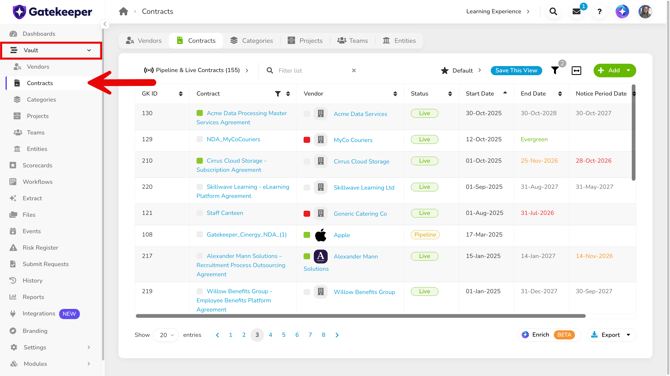
In your list view, you can display date columns, such as Start Date, End Date or Notice Period Date, and sort contracts by these key dates. See Configure Your Vault List Views for details on managing the columns that display.
End dates and notice period dates display in red when less than 4 weeks remain, orange for 4 to 8 weeks, and black for more than 8 weeks. Evergreen contracts, which have no expiry date, display in green.
To view the dates for an individual contract, click the relevant contract record to open it.
Contract Records
The contract summary is the first section to appear on a contract record's Data tab. It displays the Expires in field, which calculates the time remaining until the end date. If Expires in is 0 or less than 0, the status shows as Overdue.
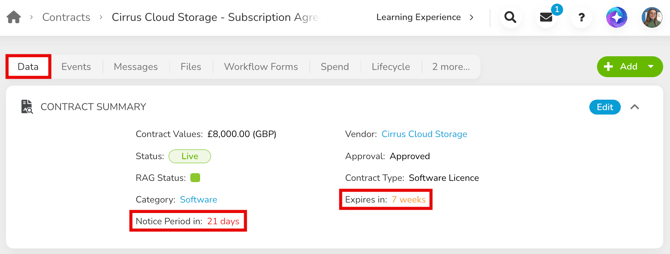
Scroll to the Contract Dates section to view the Expires in, Notice Period in, Start Date, End Date, and Term fields.

Reporting on Contract Dates
The End Date and Notice Period Date fields drive valuable Dashboard metrics, such as the Contract Renewals Timeline.
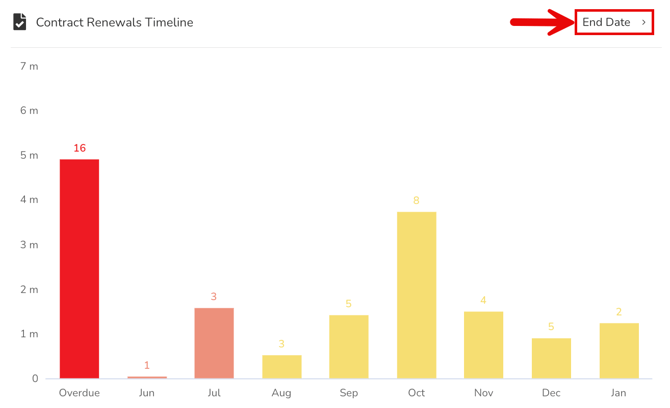
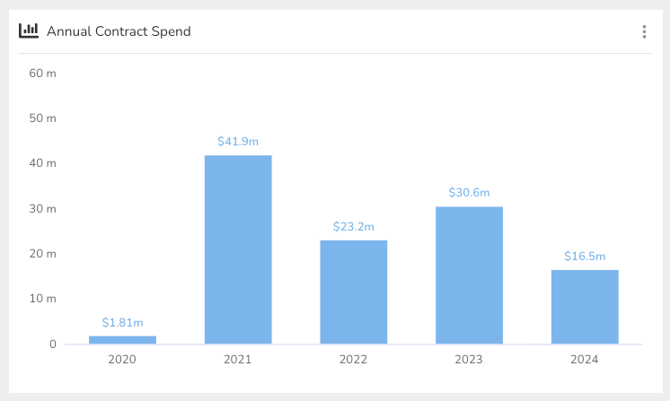
You can also use dates when creating custom dashboard visualisations.
Add Contract Dates
You can set contract dates when you create a contract, or add or amend them at any point afterwards. As with any other contract detail, this can be done directly in the Vault, via a workflow action, using Extract and Enrich, through bulk import, or via the API.
In a workflow, you can either set contract dates individually for each contract, using the data entered on the workflow form, or use an AutoAction to set them with a rule that applies to every contract. With an AutoAction, you can set:
- Start Date: select Contract Creation Date, or a set period after it, such as Contract Creation Date + 1 week.
- End Date: enter a number, then select months, weeks or days. The end date is calculated from the start date, using the period you set.
- Rolling Days Notice: enter a set number of days.
The notice period date can't be set automatically.
Use Contract Dates to Drive Renewals
You can drive renewals from contract dates via workflow triggers, which suit most cases and work best across many contracts, or use Auto-Archive to archive a contract on its end date.
For example, you could configure a workflow trigger to alert you 45 days before the notice period date or end date. A trigger can also alert you each year before the start date anniversary, which is useful for reviewing Evergreen contracts. A date-based trigger pulls a contract onto a workflow when one of its dates meets your condition. Triggers are checked every hour. You can base a trigger on End Date, Notice Period Date, Start Date Anniversary or a custom date field. Rolling Days Notice can't be used as a trigger condition.
When configuring conditions, date-based triggers offer two options:
-
Occurs in matches a contract when its date is exactly the number of days you set from today. A contract added when its date is already closer than that won't match.
-
Occurs in less than or equal to matches a contract when its date is the number of days you set from today or fewer, including contracts already inside that window. It keeps matching after the date has passed, so a contract can be pulled in again once its card is complete if the condition is still true, for example, if the contract end date hasn't been updated.
FAQs