Estimated Read Time: 13 minutes
Sections in this article:
- What is a Workflow Action?
- Enable an Action on a Phase
- Available Workflow Actions
- Additional Action Settings
- FAQs
Note: For background on workflows, see An Introduction to the Kanban Workflow Engine. Want to learn more? For an interactive overview of workflow actions, head to the Gatekeeper Academy course on Workflow Actions.
What is a Workflow Action?
A workflow action is a task performed within a workflow that modifies Gatekeeper records outside the workflow. These actions streamline administrative processes by ensuring data is correctly processed and stored. For example, actions can be used to:
- Create a new contract or vendor record
- Update an existing contract or vendor record
- Upload a new version of a contract document
- Send a document for eSignature
Note: At least one action must be configured on every workflow. Without one, data collected during the process will not create or update any records in Gatekeeper.
Manual vs Automatic Actions
Workflow actions can be categorised as:
- Manual Actions: Performed by users who open a card and click an action button to perform the relevant task. For example, they might create a contract record manually by reviewing the form data and making updates at the same time.
- Automatic Actions (AutoActions): Performed automatically by Gatekeeper when a card reaches a phase where they are enabled. For example, a contract record can be created automatically using submitted form data, as well as any pre-set values.
Note: AutoActions can fail if certain conditions aren't met. For example, a contract can't be created if mandatory fields are missing.
Enable an Action on a Phase
Note: To configure workflow actions, users must be a Workflow Administrator or Local Workflow Administrator. To learn more, see Workflow Authorisation Overview.
To learn how to configure actions on a workflow, watch the video demonstration or follow the steps below:
- From the navigation menu, click Workflows.
- Click the relevant workflow to edit it.
- Click the phase that requires an action to edit it.
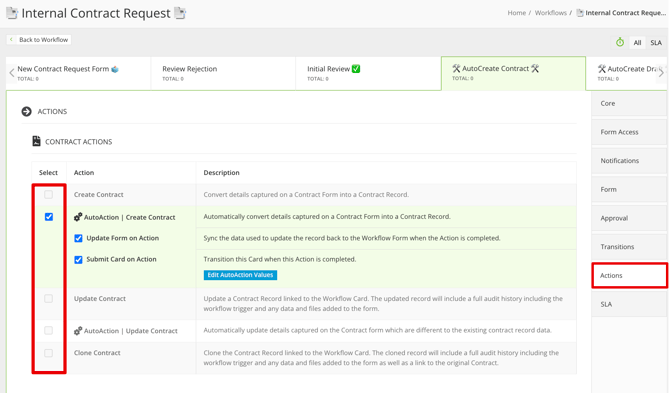
- Click Actions, then select the appropriate checkbox to enable the action.
Note:
- Actions cannot be configured in the first phase of a workflow, as this is used to initiate a process.
- Some actions are unavailable in a given phase if others have already been enabled. These will appear greyed out to indicate they cannot be selected.
Available Workflow Actions
The following sections will detail the various actions available within a workflow phase.
Contract Actions
These actions will be available to select if the predefined contract section with the core contract metadata fields has been added to the workflow form.
| Action | Description | Notes |
| Create Contract |
Prompts the user to review form data and complete any missing details in order to manually create a new contract record. 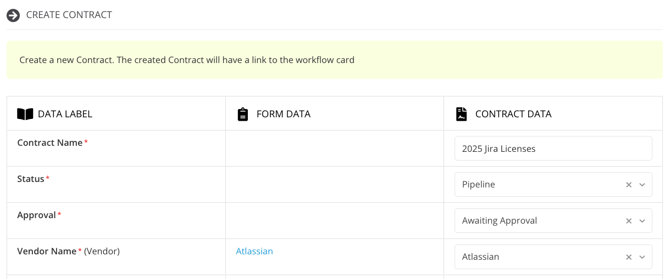 |
If Create Vendor is also needed, enable the actions in separate phases, with the vendor created first. |
| AutoAction | Create Contract | Automatically generates a new contract record without user input. This uses the data submitted in the form, as well as any pre-set values. | If Create Vendor is also needed, enable the actions in separate phases, with the vendor created first. |
| Update Contract |
Prompts the user to review submitted details and compare them with the original data before manually updating an existing contract record. 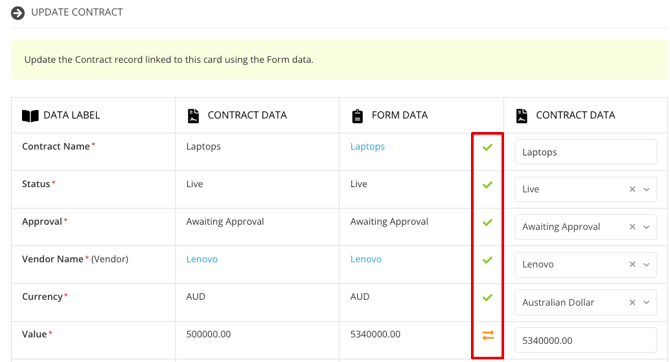 |
|
| AutoAction | Update Contract | Automatically applies form data to an existing contract without user input. This uses the data submitted in the form, as well as any pre-set values. | |
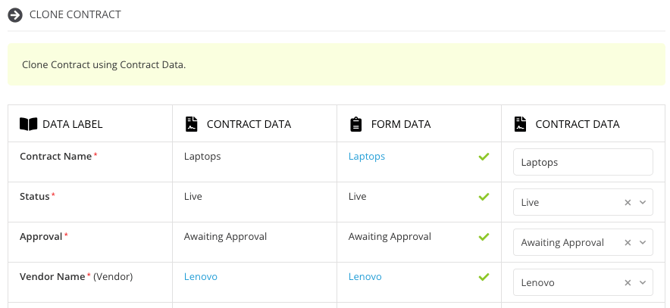
| Clone Contract |
Prompts the user to duplicate an existing contract record, creating a new, linked version in your repository. This includes audit history and attached files.
|
This will not be available if the contract you are trying to clone was created as part of the same workflow. |
| AutoAction | Clone Contract |
Automatically generates a new contract record without user input by duplicating the existing linked contract. This uses the data from the original contract, as well as any pre-set values. |
This will not be available if the contract you are trying to clone was created as part of the same workflow. |
Vendor Actions
These actions will be available to select if the predefined vendor section with the core vendor metadata fields has been added to the workflow form.
| Action | Description | Notes |
| Create Vendor | Prompts the user to review form data and complete any missing details in order to manually create a new vendor record.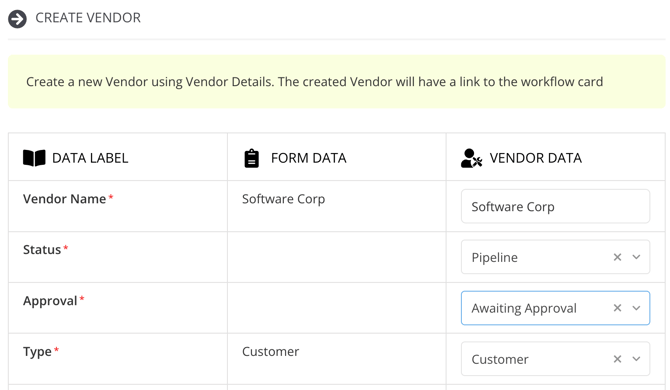 |
If Create Contract is also needed, enable the actions in separate phases, with the vendor created first. |
| AutoAction | Create Vendor | Automatically generates a new vendor record without user input. This uses the data submitted in the form, as well as any pre-set values. | If Create Contract is also needed, enable the actions in separate phases, with the vendor created first. |
| Update Vendor |
Prompts the user to review submitted details and compare them with the original data before manually updating an existing vendor record. 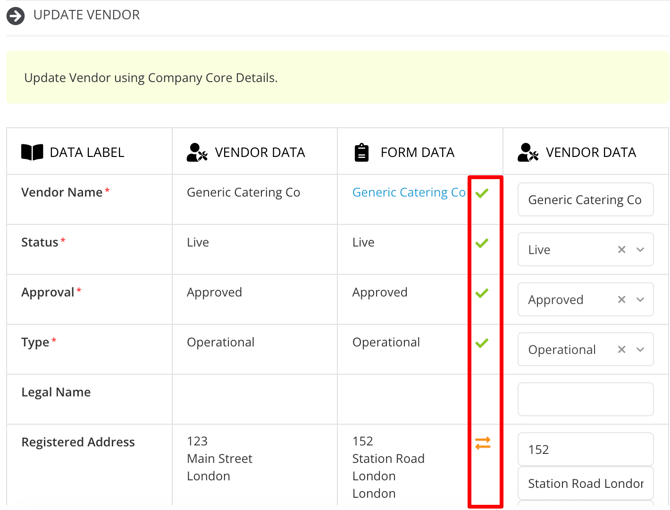 |
|
| AutoAction | Update Vendor | Automatically applies form data to an existing vendor without user input. This uses the data submitted in the form, as well as any pre-set values. | |
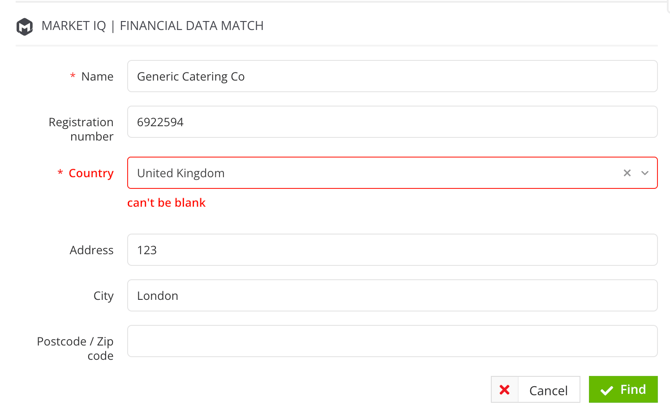
| Update Vendor with Market IQ | Financial |
Prompts the user to link a vendor with Market IQ Financial by entering the relevant details to find the correct company. |
Requires the Market IQ Suite. This action is not available with Market IQ Lite. |
| Invite / notify Card Owner to the Vendor Portal | Sends an invitation email to the card owner for the Vendor Portal if they are not already invited. | Can only be selected on a Vendor Portal phase. |
eNegotiate Actions
These actions relate to the eNegotiate process, which allows you to create, redline, publish and sign a contract document via Gatekeeper workflows. See Configure eNegotiate for further details.
| Action | Description | Notes |
| Create Contract with eNegotiate Draft |
Prompts the user to create a new contract record and generate a draft using an eNegotiate contract template and the details submitted in the form. |
Available options depend on which eNegotiate templates are configured for specific contract types. |
| Create Contract and associate a Contract Master Draft | Prompts the user to create a new contract record and upload a .doc, .docx, or .pdf as the master draft, or select one already uploaded within the workflow form.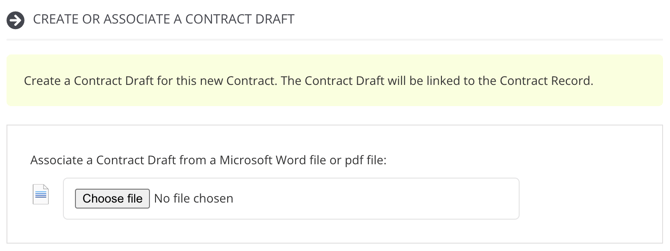 |
See Create Contract and Associate a Contract Master Draft for a full walkthrough. |
| Generate Draft from Contract | Prompts the user to generate a draft using an eNegotiate contract template and the details submitted in the form, which is then automatically linked to an existing contract record.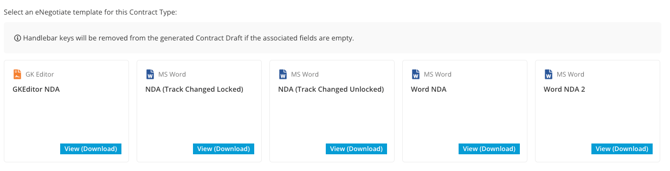 |
Contract record must already exist. Available options depend on which eNegotiate templates are configured for specific contract types. |
| Associate a Contract Master Draft | Prompts the user to upload a .doc, .docx, or .pdf as the master draft, or select one already uploaded within the workflow form, which is then automatically linked to an existing contract record. |
Contract record must already exist. |
| AutoAction | Associate a Contract Master Draft | Automatically selects a file uploaded via the workflow form as the draft and links it to an existing contract record. You can configure whether this uses the Intake file or a specific file upload field. | Contract record must already exist. |
| Submit Contract Draft | Allows the user (internal or external) to download the current draft, upload a revised version for negotiation or review, or accept or reject the existing draft.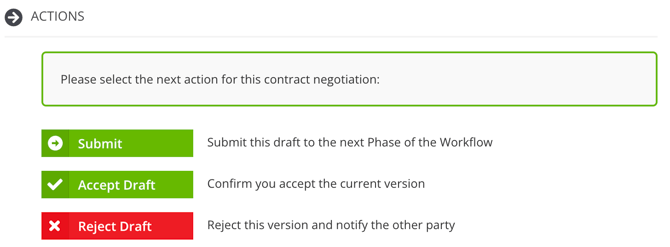 |
Office for the web, Google Docs, or OneDrive allows users to edit documents and save changes back to that platform. Email - Submit & Approval Only |
| Publish Contract Draft & Upload PDF | Prompts the user to confirm the current draft is final and upload a signed .pdf file.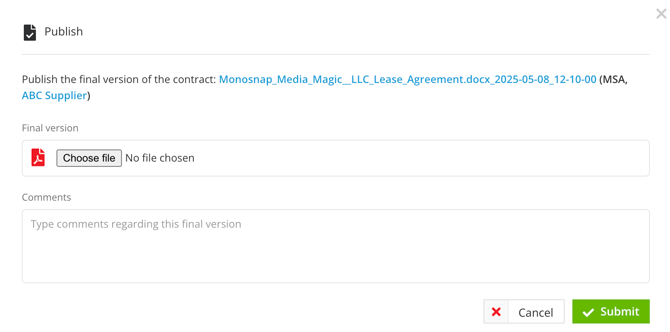 |
See Publish Contract Draft & Upload PDF for a full walkthrough. |
| Upload Signed Document | Prompts the user to upload a document signed outside of Gatekeeper as the final version and marks this as the Master Record.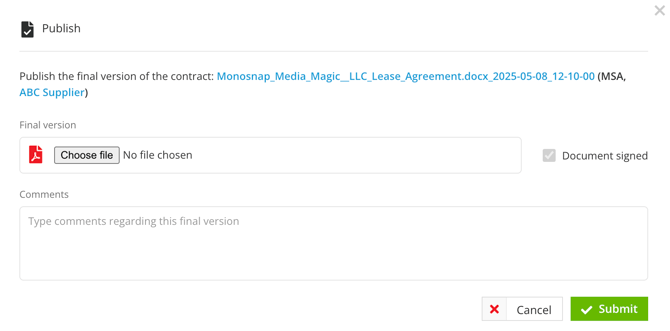 |
See Upload Signed Document for a full walkthrough. |
| Publish Contract Draft & Convert MS Word to PDF | Prompts the user to confirm the current draft is final, then automatically converts the .doc or .docx file into a .pdf file.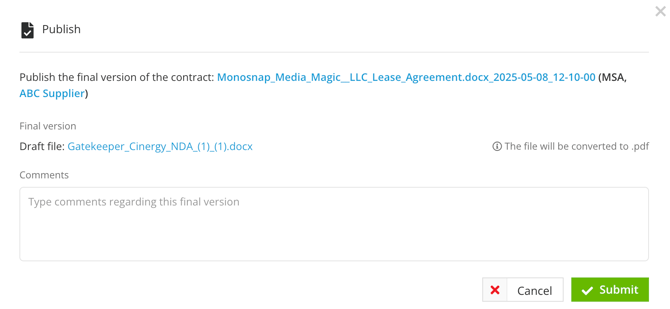 |
See Publish Contract Draft & Convert MS Word to PDF for a full walkthrough. |
| AutoAction | Generate Draft from Contract | Automatically generates a draft using an eNegotiate contract template and the details submitted in the form, which is then linked to an existing contract record. |
Contract record must already exist. This AutoAction will fail if no |
| AutoAction | Publish Contract Draft & Convert MS Word to PDF | Automatically converts the .doc or .docx file into a .pdf file. |
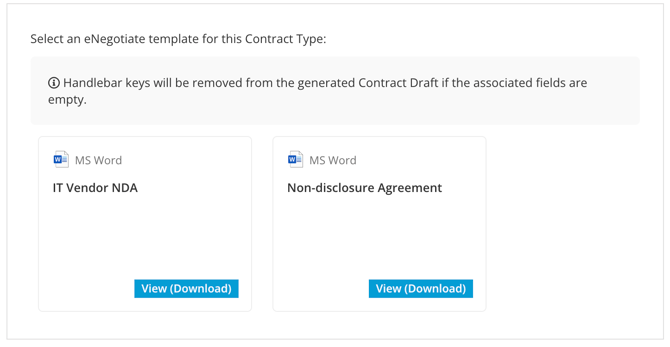
Note: Some actions can be enabled together to give users a choice between options. For example, selecting Generate Draft from Contract and Associate a Contract Master Draft allows users to select a template or upload a new file.
eSignature Actions
These actions can be used when a document is ready for signature.
| Action | Description | Notes |
| Enable eSign |
Prompts the user to initiate a digital signature process via eSign by manually configuring the signatories and sending it to them. |
Inline Only eSign prevents Display Approval History shows internal signatories all workflow approvals for the card. |
| Enable DocuSign | Prompts the user to initiate a digital signature process via DocuSign by manually configuring the signatories and sending it to them. | Requires the DocuSign integration. |
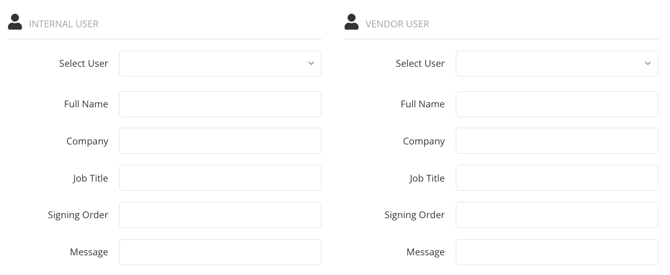
| AutoAction | Send for eSign |
Automatically initiates the eSign process using the .pdf file associated with the workflow card, and assigns the internal and external contract owners as signatories. Ensure that:
|
External Signatory only requires only the external owner to sign the document. Display Approval History shows internal signatories all workflow approvals for the card. |
Additional Action Settings
The following sections detail the settings available after selecting an action.
Edit AutoAction Values
When an AutoAction is enabled, by default Gatekeeper will use the values submitted in the form to execute the action. To amend this, click Edit AutoAction Values to determine whether the action will use the values input by the form submitter, or a pre-set value that you've configured.
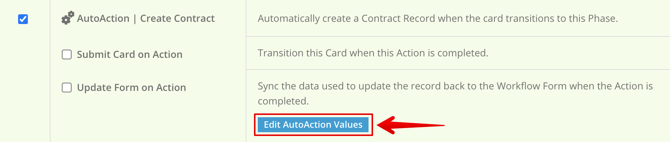
For example, in a contract request workflow you may have an initial Create Contract AutoAction, so could apply a Pipeline status to indicate the contracts haven’t yet been executed.
To configure this:
- Click Edit AutoAction Values.
- Deselect the Take Value from Form checkbox for any fields you want to be hardcoded.
- Select the value you want the AutoAction to apply to cards.
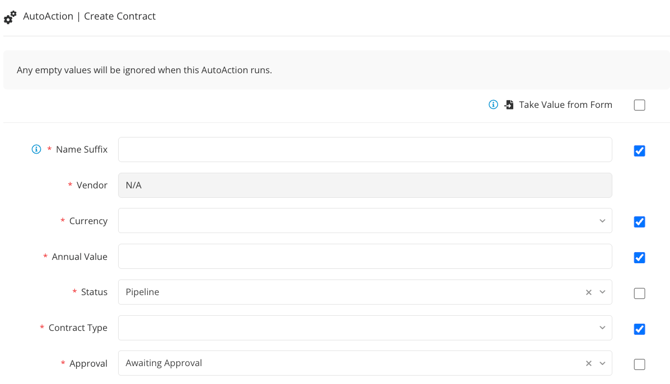
- Click Save to apply the changes.
Note:
- If Take Value from Form is selected and a value is also set in the AutoAction:
- The value provided in the form will be used, if present.
- If the form field is blank, the AutoAction value will be used instead.
- For an update action, if the value is blank, the field is skipped and its existing value on the record stays unchanged. You cannot use an AutoAction to clear a field.
- If none of the fields have Take Value from Form selected, the AutoAction may fail to run.
- Edit AutoAction Values is not available on Publish Contract Draft & Convert MS Word to PDF or Send for eSign.
Assigning Contract Owners
You can use AutoActions to assign an internal contract owner to a record using one or more of the following options:
- Hardcoded Value: sets a specific user
- Take Value from Form: uses the form field input (if provided)
- Card Creator: assigns the user who created the card
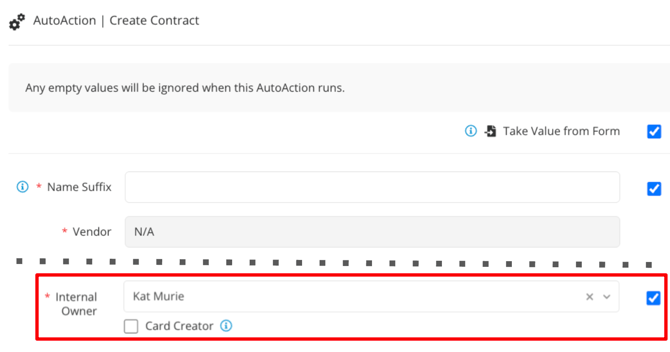
If multiple options are selected, the system will assign the owner based on this order:
- Form value (if provided)
- Card Creator
- Hardcoded value
For example, if both Take value from form and Card Creator are selected, the form value will take priority. If that field is blank, the card creator will be used.
Note: For details of how the Card Creator is selected for a triggered workflow, see Configure Workflow Phase Access and Ownership.
Submit Card on Action
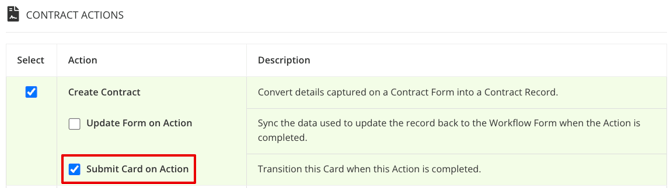
Some manual and AutoActions include an additional Submit Card on Action checkbox. When selected, cards on these phases will automatically transition to the next phase when a user completes the action.
Update Form on Action
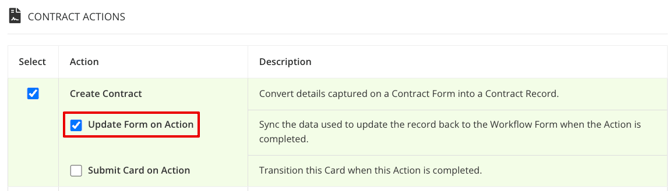
Some manual and AutoActions include an additional Update Form on Action checkbox. When selected, the data used to execute the action is synced back to the workflow form. For example, if a Create Contract AutoAction applies a Pipeline status to the new record, the same status will also be populated in the workflow form to keep both in sync.